

Whisky starts with fermentable grains:
Barley (malted or unmalted) – Classic for Scotch & Irish whisky.
Corn – Sweet, smooth base for Bourbon (must be ≥51% in the U.S.).
Rye – Spicy, bold flavor in American rye whisky.
Wheat – Soft, mellow profile (e.g., wheated Bourbon).
Water quality matters! Minerals in local water (e.g., Scotland's peat-rich streams) influence fermentation and taste.
2. Malting & Mashing (Preparing the Wash)
(Image: Germinating barley on a malting floor.)
A. Malting (For Scotch & Some Whiskeys)
Steeping – Barley soaks in water to trigger germination.
Germination – Enzymes convert starches into fermentable sugars.
Kilning – Drying halts germination; peat smoke adds smokiness (optional).
B. Mashing
Grains are ground into grist and mixed with hot water in a mash tun.
Enzymes break starches into sugars, creating a sweet liquid called wort.
3. Fermentation: Turning Sugar into Alcohol
*(Image: Wooden or stainless steel washbacks bubbling with fermentation.)_
The wort is cooled and transferred to fermentation vessels (washbacks).
Yeast is added, converting sugars into alcohol (~5-10% ABV) over 48–96 hours.
The resulting liquid, called wash, resembles a strong beer.
Flavor Note: Longer fermentation (up to 120 hours) creates more fruity esters.
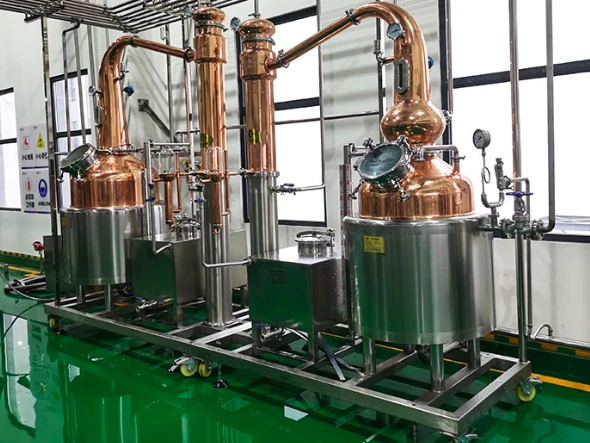
4. Distillation: Separating Alcohol from the Wash
A. Pot Still Distillation (Traditional Method)
(Image: Copper pot stills with a spirit safe.)
First Distillation (Wash Still)
The wash is heated, producing low wines (~20-30% ABV).
Second Distillation (Spirit Still)
Low wines are re-distilled, separating:
Foreshots/Heads (toxic methanol, discarded).
Hearts (ethanol, the good stuff, saved for aging).
Feints/Tails (oily, smoky compounds, often recycled).
Key Factor: The shape of the still (swan neck, lyne arm angle) affects reflux and flavor.
B. Column Still Distillation (For Bourbon & Grain Whisky)
Continuous distillation produces higher ABV (~90%) and a lighter spirit.
Often used for Bourbon, Tennessee whiskey, and blended Scotch grain whisky.
5. The Cut: Selecting the "Heart" of the Spirit
*(Image: A distiller testing the spirit flow with a hydrometer.)_
Heads (first 5-10%) – Harsh, acetone-like; discarded.
Hearts (middle 60-70%) – Smooth, fruity, floral; kept for aging.
Tails (last 20-30%) – Oily, funky; sometimes blended back for depth.
Master Distiller's Secret: The cut timing varies by style-Scotch keeps more tails for smokiness, while Bourbon favors cleaner hearts.
6. Aging: Where Magic Happens
*(Image: Charred oak barrels in a rickhouse.)_
New-make spirit is aged in oak barrels (legally required for whisky).
Bourbon → Must use new charred oak barrels.
Scotch/Irish → Often aged in ex-Bourbon or sherry casks.
Time Matters:
2–3 years → Young, fiery spirit.
10+ years → Deep vanilla, spice, and oak complexity.
7. Bottling: The Final Step
Whisky is often filtered (chill-filtering removes cloudiness).
Some brands add water to adjust ABV (e.g., from cask strength to 40-46%).
Single malt = One distillery, pot stills.
Blended whisky = Mix of grain & malt whiskies.


