

Fermenting System
Your Professional Fermenting System Supplier
Shandong Dehui Fermentation Intelligent Equipment Company was founded in 2016, mainly engaged in beer, wine, distillery and other complete equipment research and development, production, sales and service.After 8 years of development, Dehui has become a professional brewing equipment manufacturer and supplier, providing professional brewing equipment for global users.Main procuducts of the company includes beer brewing equipment,fruit wine equipment,winery equipment,distillation equipment etc.
-
 Top Manhole Fermentation TankFermentation is the core and indispensable procedure in beer brewing. All our fermenters are made of stainless steel, available in single-layer and double-layer versions to match your brewing...Add to Inquiry
 -
 Stainless Steel Fermentation TanksPremium Sanitation Non-absorbent surface stops bacteria and supports full CIP & SIP cleaning. Long Service Life Corrosion and pressure resistant for years of heavy-duty brewing. Pure Beer...Add to Inquiry
 -
 Horizontal Fermentation TankHorizontal beer tanks facilitate sedimentation of yeast and impurities. Less filtration is required, delivering clearer beer while fully preserving its original flavor and aroma.Add to Inquiry
 -
 Kombucha open top fermentation tankA malt milling machine is an essential piece of brewing equipment designed to crush malted grains efficiently while preserving husk integrity. Proper milling improves mash efficiency, lautering...Add to Inquiry
 -
 Clean In Place MachineHorizontal bright beer tanks are used in brewing mainly for beer conditioning after fermentation. Compared with traditional vertical tanks, their horizontal orientation allows more efficient use...Add to Inquiry
 -
 Horizontal Serving TankHorizontal bright beer tanks are used in brewing mainly for beer conditioning after fermentation. Compared with traditional vertical tanks, their horizontal orientation allows more efficient use...Add to Inquiry
 -
 Conical Beer FermenterDehui can design fermentation and bright beer tank with differentvolume, diameter, height, different-type cooling jacket according tocustomer's requirement. The tank's advantages are :...Add to Inquiry
 -
 Commercial Kombucha Brewing Equipment ManufacturerWhat is Kombucha Equipment Well, here is a detailed explanation about "Kombucha Equipment". In simple terms, kombucha brewing equipment refers to a complete set of tools and containers needed...Add to Inquiry
 -
 Side Manhole Fermentation Tank SupplierThis is a very common fermentation tank design in both craft breweries and large breweries. As the name suggests, its core feature is that the manway is located on the side of the tank rather than...Add to Inquiry
 -
 Single Wall Fruit Wine Fermentation TankFeatures: Material: SS304/SS316 Surface: Inner 2B, outside brushed oil, all welds are passivated and polished; inside welds are ground. Polished is optional Sprinkle and circle pipe pump juice...Add to Inquiry
 -
 Manhole Fermentation Tank ManufacturerChoosing conical-bottom fermentation tanks (especially CCT, namely conical tank fermentation technology) is the mainstream trend in modern beer production. This is mainly because it can...Add to Inquiry
 -
 Side Manhole Fermentation Tank For SalePrecise Temperature Control & Efficient Fermentation - Utilizing food-grade stainless steel and an intelligent temperature control system, it ensures vigorous yeast activity and pure, rich...Add to Inquiry


Why Choose Us
Production equipment
Main procuducts of the company includes beer brewing equipment,fruit wine equipment,winery equipment,distillation equipment etc.
Customized solutions
Shandong Dehui Fermentation Intelligent Equipment Co., Ltd. was established in 2016, specializing in the production of complete equipment solutions for beer, wine, coffee, and other fermentation industries.
Our certificates
The company has passed CE, PED certification, pressure vessel equipment certification and obtained more than 30 patent certification.
Sales Market
We Products are exported to Europe, the United States, Asia and other countries and regions.
Advantages of Fermenting System
Consistency and Quality
Using a dedicated fermentation vessel ensures consistent temperature and pressure, resulting in more uniform fermentation vessel beer. This consistency is crucial for brewers who wish to replicate successful batches.
Easier Monitoring
Most fermentation vessels come equipped with features that facilitate easy monitoring of the fermentation process. Clear carboys allow visibility of fermentation activity, while conical fermenters often include pressure gauges and thermometer ports for precise measurements.
Improved Hygiene
Fermentation vessels designed for brewing are made from materials that are easy to clean and sanitize. Proper sanitation is critical in producing high-quality fermentation vessel beer, as it prevents contamination and allows yeast to work effectively.

Specification
|
Parameter |
Cylindroconical Tank (CCT) |
Open Fermenter |
Horizontal Tank |
UNITANK |
Homebrew/Small Scale |
|
Typical Capacity |
1,000–500,000 L |
100–10,000 L |
500–50,000 L |
500–100,000 L |
20–500 L |
|
Material |
304/316 Stainless Steel |
Stainless Steel/Wood |
Stainless Steel/Oak |
304/316 Stainless Steel |
PET/Stainless Steel |
|
Design |
Vertical, conical bottom (60–75°) |
Open-top or shallow cover |
Horizontal cylinder |
CCT + dual-purpose design |
Bucket/carboy with airlock |
|
Temperature Control |
Yes (glycol jacket ±0.5°C) |
Limited (ambient/cooling) |
Yes (jacket) |
Yes (jacket + pressure) |
Manual (external cooling) |
|
Pressure Range |
0–1.5 bar (adjustable) |
Atmospheric |
0–0.5 bar |
0–2 bar (carbonation) |
Atmospheric |
|
Yeast Management |
Excellent (cone harvest) |
Poor (manual skimming) |
Moderate (sedimentation) |
Excellent (cone harvest) |
Manual transfer |
|
Fermentation Time |
5–14 days (lager/ale) |
3–7 days (ale) |
7 days–6+ months (aging) |
7–21 days (all-in-one) |
7–14 days |
|
CIP Cleaning |
Fully automated |
Manual/partial automation |
Semi-automated |
Fully automated |
Manual |
How Does an Fermenting System Work

Hops and Grains Selection
The brewing journey begins with selecting the finest hops and grains. Automated systems give brewers the freedom to experiment with different combinations, creating unique flavor profiles.
Mash Process
During the mash process, crushed grains are mixed with hot water to convert starches into fermentable sugars. The automated system ensures precise temperature control and agitation for optimal sugar extraction.
Boiling and Hopping
Boiling the wort is a critical step in the brewing process, and automated systems handle this with precision. Brewers can add hops at specific intervals to impart bitterness, flavor, and aroma to the beer.
Fermentation
Automated brewing systems carefully regulate fermentation temperatures, enabling yeast to work its magic and produce alcohol and carbonation.
Conditioning
After fermentation, the beer undergoes conditioning, where flavors mature and settle. The automated system maintains ideal conditions for the best results.
Key Components of Fermenting System
Fermentation Vessels
These are tanks where wort is placed with yeast to start the fermentation process. They come in various sizes, from small homebrew setups to massive industrial tanks.
Airlocks
An airlock allows carbon dioxide (produced during fermentation) to escape the vessel without letting any contaminants in.
Temperature Control Systems
Fermentation temperature has a significant influence on the taste of the beer. Many brewers use temperature control systems to ensure the beer ferments at the desired temperature.
Key Elements Of a Fermenting System


Fermentation Tanks (FVs)
Shape and Design: Fermentation tanks come in different shapes—most commonly vertical or horizontal. Vertical fermenters are most widely used because they allow the yeast to rise and settle naturally.
Volume: The size can range from small (for pilot batches) to large (for commercial brewing), and the number of tanks will vary based on production volume.
Material: Stainless steel is the go-to material for fermenters because it's resistant to corrosion and easy to clean.
Temperature Control
Jacketed Tanks: Fermentation produces heat, so it’s essential to maintain an optimal fermentation temperature. Jacketed tanks (tanks with an external jacket that circulates cooling or heating fluid) are used to control the temperature.
Temperature Monitoring: Fermentation can get out of hand if the temperature isn't regulated, so most systems come with built-in temperature probes or control units to monitor the fermentation progress.
Oxygenation and Aeration
Oxygenation: Before fermentation begins, the wort needs to be oxygenated to help yeast grow. This is often done using an aeration stone or oxygen tank to infuse oxygen into the wort.
Aeration: After the wort is cooled and before adding yeast, brewers aerate it to give yeast the oxygen needed for healthy fermentation.
Yeast Management
Yeast Pitching: Yeast is typically added to the cooled wort to start fermentation. The amount and type of yeast used can significantly affect the beer’s flavor and characteristics.
Yeast Propagation: Some systems include yeast propagation vessels where yeast is cultured and expanded before pitching into the main fermenter.
Pressure Relief and Ventilation
Pressure Relief Valve (PRV): Fermentation creates CO2, which can build up pressure in the tank. PRVs allow excess gas to escape without damaging the vessel.
Blow-off Tubes: Some brewers use blow-off tubes connected to the fermenter to allow excess CO2 or krausen (foam from the yeast) to escape, especially during the first days of active fermentation.
Clarification and Maturation
After fermentation, the beer usually goes through a maturation phase in bright tanks (like horizontal or vertical bright tanks). This helps the beer clarify and settle before it’s packaged.
Secondary Fermentation: Some systems allow for secondary fermentation in a separate tank where additional yeast is added to enhance carbonation or flavor complexity.
Automation and Control Systems
Automated Systems: Many commercial breweries use automated fermentation control systems that track temperature, pH, and fermentation time, giving brewers real-time data to ensure consistency.
Monitoring: Some modern fermentation systems include sensors to detect alcohol content, pH, gravity, and other parameters to ensure the fermentation process stays on track.
Cleaning and Sanitization
CIP (Clean in Place): Fermentation tanks often come with CIP systems that allow for efficient cleaning without disassembling parts of the system. This is crucial for preventing contamination and maintaining the quality of the beer more.
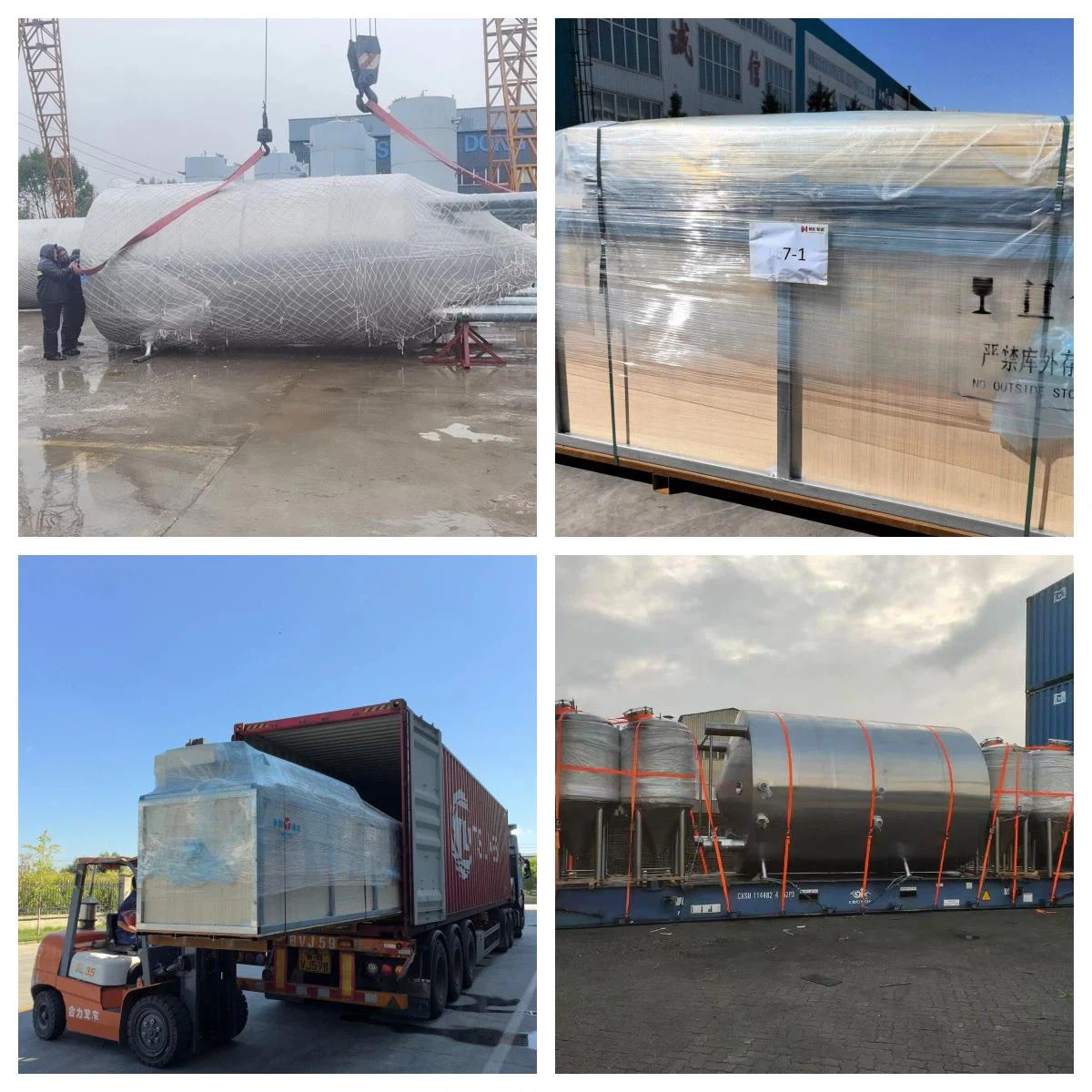
Packing & Shipping
FAQ
As one of the leading fermenting system manufacturers and suppliers in China, we warmly welcome you to buy high-grade fermenting system for sale here from our factory. All machines are with high quality and competitive price.
