


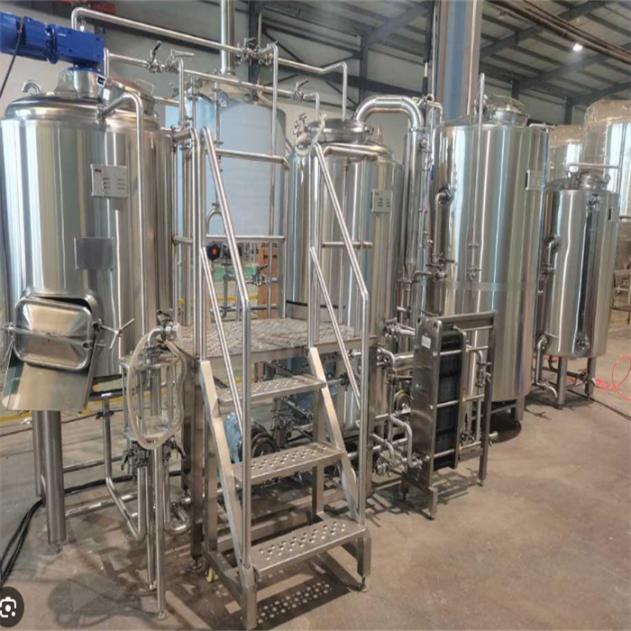
For a craft beer bar, the brewing equipment is more than just production tools-it's the heart of the customer experience. Typically, the setup should embody these key characteristics:
Brewery-Integrated Taproom: The equipment is installed directly within the bar space, allowing customers to see the brewing process firsthand. This enhances their experience and builds trust.
Moderate Production Scale: The system must be capable of meeting daily demand while allowing for regular rotation of beer styles. This keeps the offerings fresh and exciting, without the massive capacity of industrial-scale breweries.
Aesthetic Appeal: The design and layout of the equipment are integral to the bar's decor, featuring a distinct industrial aesthetic that complements the overall ambiance.
Application
MMicro Brewery Equipment
icro Brewery Equipment
Core Brewing Facilities
These establishments treat beer production as their primary business or an integral part of their core operations.
Microbrewery
Profile: This is the most typical model. It focuses on producing bottled/canned beer or supplying bars and restaurants via kegs for sales and distribution. Brand building and channel sales are crucial.
Brewpub
Profile: This "front-shop, back-factory" model has the brewing equipment installed directly within the restaurant/bar. The beer produced is primarily for immediate consumption by patrons on-site. It represents the most integrated model of production and sales, significantly enhancing the customer experience.
Craft Beer Workshop / Experience Center
Profile: The focus here shifts more towards experience and education. Customers can witness the brewing process, participate in brewing classes, and even brew their own beer. The equipment serves a dual purpose of both production and display.


Parameters
Micro Brewery Equipment
| Category | Parameter | Typical Specification / Description | Importance / Note |
|---|---|---|---|
| System Capacity | Batch Size | 1 - 10 BBL (1 BBL ≈ 117 liters) | Defines the volume of beer produced per brew cycle. It's the primary measure of scale. |
| Annual Potential Output | 150 - 1,500 BBL (highly variable) | Depends on batch size, fermentation time, and operational efficiency. | |
| Brewhouse Vessels | Mash Tun | Volume: Matches batch size. Material: 304 or 316L Stainless Steel. Insulation: Jacketed for heating/cooling. | Where grains are steeped in hot water to convert starches to sugars. |
| Brew Kettle / Whirlpool | Volume: Slightly larger than mash tun. Heating: Direct fire, steam, or electric. | For boiling the wort with hops. Often combines boiling and whirlpooling (trub removal) functions. | |
| Fermentation & Maturation | Fermenters | Volume: 2x batch size (e.g., 10 BBL fermenter for a 5 BBL batch). Pressure Rating: 1 - 2 bar (15 - 30 PSI). Cooling: Jacketed with glycol. | Where yeast ferments wort into beer. Unitanks (fermenting & bright beer tank in one) are standard. |
| Bright Beer Tanks (BBT) | Volume: Similar to batch size. | For carbonating, clarifying, and storing finished beer before packaging. (Often integrated in Unitanks). | |
| Utilities & Services | Heating Source | Steam (from a boiler), Direct Fire (natural gas), or Electric Elements. | Choice impacts energy costs, heating speed, and local code requirements. Steam is most professional. |
| Glycol System | Chiller Capacity: Sized for total fermenter volume. Glycol Temperature: -2°C to -5°C (28°F to 23°F). | Critical for controlling fermentation temperature and crashing beer. | |
| Water & Waste | Water Requirement: ~5-7x the beer volume. Effluent (Wastewater): High in organic load. | A key operational cost and environmental consideration. | |
| Control System | Automation Level | Manual, Semi-Automated (Pneumatic valves), or Fully Automated (PLC with touchscreen). | Affects consistency, labor requirements, and initial investment. Semi-automated is common. |
| Physical Specifications | Footprint | Varies greatly; a 5 BBL system may require 50 - 100 m² (500 - 1,000 ft²). | Must include space for raw materials, packaging, and movement. |
| Ceiling Height | Minimum 4 - 5 meters (13 - 16 feet), depending on fermenter height. | Critical for vertical installation and clearance of tall tanks. |
Feature
Micro Brewery Equipment
1. Flexibility & High Customizability
Small-Batch Production: Enables brewers to experiment at a low cost, allowing for continuous iteration of new recipes, hop varieties, and fermentation techniques. This is the lifeblood of craft beer innovation.
Recipe Versatility: A single system can effortlessly produce a wide range of beer styles, from Stouts and IPAs to Lagers and Sour Ales.
Customization Options: Brewers can customize equipment details to suit their specific process preferences, such as specialized mash tun filtration systems or additional dry-hop ports.
2. Compact Footprint
Space Efficiency: The designs are typically very compact, with many systems utilizing "two-vessel" or "three-vessel" layouts that significantly save space.
Adaptability to Diverse Locations: This allows them to be installed in non-traditional spaces, such as behind a bar, in a restaurant corner, a basement, or within a commercial complex.
3. Moderate Initial Investment & Operational Costs
Lower Barrier to Entry: Compared to multi-million industrial production lines, small-scale equipment makes entrepreneurship accessible for individuals or small teams.
Scalability: Many brewers start with a 1-2 barrel system and then add more fermentation tanks or upgrade their system as their brand grows, allowing for phased investment.
4. Emphasis on Manual Control & Craftsmanship
Manual/Semi-Automated Operation: Unlike fully automated industrial lines, small-scale systems require the brewer to be hands-on, making manual controls and decisions for each step like mashing, boiling, and cooling.
Process-Oriented: This "hands-on" approach allows the brewer to make subtle adjustments based on the specific batch of ingredients, prioritizing ultimate flavor expression over sheer efficiency.
5. Visually Appealing Design & Display Value
Aesthetics: The equipment itself, often made of highly polished stainless steel with clean piping layouts, is visually attractive.
Part of the Experience: In brewpubs or taprooms, these gleaming tanks are displayed directly to customers, enhancing the "brewed-on-site, fresh-from-the-tank" experience and building trust.
6. Multi-Functionality & Integration
All-in-One Capability: Modern small-scale equipment often integrates multiple functions. For example, many fermenters can serve as "multi-purpose Unitanks," capable of handling fermentation, clarification, carbonation, and storage within a single vessel.
Products Production


Packing & delivery

Certificate

Customer Review

Hot Tags: bar brewery equipment, China bar brewery equipment manufacturers, suppliers, factory, 3 tier home brewing system, advanced home brewing equipment, best all in one beer brewing system, best beer brewing system, commercial brewing equipment, large home brewing systems


