

4 Vessels Brewhouse System
Commercial 4 Vessel Brewhouse System
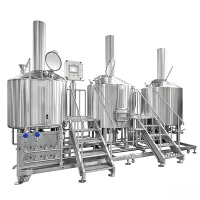
Dehui manufactures 4-vessel brewhouse systems for commercial breweries, craft beer producers and brewery projects. Each system consists of a Mash Tun, Lauter Tun, Brew Kettle and Whirlpool Tank, with separate vessels for the four main wort-production stages.
Batch capacity, heating method, automation and equipment layout can be configured according to production targets, brewing processes and site conditions. Dehui also supplies supporting equipment for individual installations and complete brewery projects.
-
 4 Vessels Craft Beer Brewhouse SystemAdvantages of a 4-Vessel Brewhouse A traditional four-vessel brewhouse (with dedicated Mash Tun, Lauter Tun, Brew Kettle, and Whirlpool) is the industry benchmark for uncompromised quality,...Add to Inquiry
-
 Copper 4 Vessels Brewhouse SystemCopper exterior plating delivers an upscale, retro aesthetic to brewing systems, making them extremely popular for small-scale setups inside restaurants, hotels and craft beer bars. You can place...Add to Inquiry
-
 Copper Brewhouse System SupplierCopper boasts outstanding thermal conductivity, ranking second only to silver among common metals, enabling ultra-fast and even heat transfer across its surface. This characteristic delivers two...Add to Inquiry
-
 Copper Brewing Equipment For SalePurple copper beer equipment, as the name suggests, refers to beer brewing equipment mainly made of copper (pure copper). It mainly includes saccharification tanks, boiling tanks, fermentation...Add to Inquiry
-
 4 Vessels Brewhouse System ManufacturerThe four vessels brewhouse system is a combination of four independent and functionally distinct containers that form a saccharification equipment unit. These units are connected through pipes,...Add to Inquiry
-
 4 Vessels Stailnless Steel Brewhouse SystemA 4-vessel brewhouse system is a commercial brewing setup designed to streamline the beer production process by dividing it into four specialized vessels. This configuration is common in medium to...Add to Inquiry


4 Vessels Brewhouse System Specifications
|
Parameter |
Specification |
|
Model |
DH-2500 |
|
Capacity |
2,500L/Batch |
|
Material |
SUS304 Stainless Steel (All Vessels and Process Piping) |
|
Vessel Configuration |
Mash Tun, Lauter Tun, Brew Kettle, Whirlpool Tank |
|
Application |
Commercial Breweries and Brewery Projects |
|
Heating Method |
Steam Heating (Electric / Direct-Fire Heating Optional) |
|
Voltage |
3-Phase, 380V, 50Hz (Customized Voltage and Frequency Available) |
|
Automation Level |
Semi-Automatic PLC Control / Fully Automatic PLC Control |
How the Four Vessels Work
|
Vessel |
Main Function |
Typical Configuration |
|
Mash Tun |
Mixes milled malt with hot water for mashing and starch conversion |
Agitator, heating arrangement and temperature monitoring |
|
Lauter Tun |
Separates wort from spent grain |
False bottom, wort collection system and grain discharge |
|
Brew Kettle |
Boils wort and allows hop additions |
Heating system, wort inlet and vapor outlet |
|
Whirlpool Tank |
Separates hot trub from wort after boiling |
Tangential inlet and wort outlet |
Independent Vessel Operation
• Mash Tun and Lauter Tun: After mash transfer, the Mash Tun can be cleaned and prepared for the next batch while lautering continues.
• Lauter Tun and Brew Kettle: Wort is transferred to the Brew Kettle as lautering is completed.
• Brew Kettle and Whirlpool Tank: After boiling, wort is transferred to the Whirlpool Tank, freeing the Brew Kettle for the next brewing cycle.
This arrangement allows different batches to move through separate process stages, supporting more flexible brewing schedules.
Brewing Process: Mashing → Lautering → Wort Boiling → Whirlpool Separation → Wort Cooling → Fermentation
2-Vessel vs. 3-Vessel vs. 4-Vessel Brewhouse
The vessel configuration affects equipment investment, installation space and the number of brewing operations that can be handled independently.
|
Comparison Factor |
2-Vessel Brewhouse |
3-Vessel Brewhouse |
4-Vessel Brewhouse |
|
Typical Vessel Combination |
Mash/Lauter + Kettle/Whirlpool |
Mash + Lauter + Kettle/Whirlpool |
Mash + Lauter + Kettle + Whirlpool |
|
Initial Equipment Investment |
Generally lower |
Generally medium |
Generally higher |
|
Installation Space |
More compact |
Intermediate |
Generally larger |
|
Process Separation |
More stages share vessels |
Selected stages are separated |
Four main stages have dedicated vessels |
|
Operating Flexibility |
More sequential operations |
Selected operations can overlap |
More operations can be scheduled in parallel |
|
Typical Application |
Smaller brewing operations |
Growing commercial breweries |
Commercial breweries requiring flexible multi-batch scheduling |
Configuration Selection
• 2-vessel: Suitable when equipment investment and a compact installation are the main priorities.
• 3-vessel: Suitable when separate mashing and lautering operations are required.
• 4-vessel: Suitable when independent vessels for mashing, lautering, boiling and whirlpool separation are needed to support multi-batch production.
The actual investment, footprint and production rate depend on vessel capacity, equipment design, heating capacity, site layout and operating hours.
Brewhouse Production Capacity Planning
Select the brewhouse batch capacity according to the target daily wort output and planned number of brewing cycles.
Theoretical Daily Wort Output
|
Batch Capacity |
Planned Batches per Day |
Theoretical Daily Wort Output |
|
2,500L |
1 |
2,500L |
|
2,500L |
2 |
5,000L |
|
2,500L |
3 |
7,500L |
|
2,500L |
4 |
10,000L |
These figures represent calculated wort output, not finished beer volume. Actual production depends on:
• Heating Capacity: Time required for water heating and wort boiling.
• Process Duration: Mashing, lautering, boiling and whirlpooling time.
• Transfer and Cooling: Pumping capacity and wort cooling time.
• Operating Schedule: Available brewing hours and cleaning intervals.
• Automation: The selected level of temperature, pump and valve control.

Working Volume: Match the fermenter's working volume to the wort volume assigned to each tank.
Multiple-Batch Filling: Calculate the combined wort volume when several batches are transferred into one fermenter.
Headspace: Allow sufficient space for fermentation activity; distinguish working volume from total tank volume.
Tank Quantity: Account for fermentation and maturation time, filling frequency, cleaning and tank turnover.
The final fermentation tank configuration should be based on the brewery's weekly production plan rather than brewhouse batch capacity alone.
Brewhouse Customization and Automation
Equipment Configuration
• Vessel Capacity and Dimensions: Customized vessel volumes, diameters and heights.
• Heating Method: Steam, electric or direct-fire heating options.
• Vessel Structure: Agitators, lauter filtration systems, grain discharge and whirlpool configurations.
• Pumps, Valves and Piping: Configured for wort transfer and process connections.
• Material and Finish: SUS304 stainless steel for all vessels and process piping, with specified surface finishes.
Automation Options
• PLC Control: Control cabinet with touchscreen HMI for centralized operation.
• Temperature Control: Monitoring and control of mashing and wort boiling temperatures.
• Pump and Valve Control: Manual or automatic operation of transfer pumps and pneumatic valves.
• Lauter Tun Control: Rake speed and lifting control.
• CIP Control: Automated cleaning sequences for vessels and process pipelines.
Semi-automatic and fully automatic configurations are available. Control functions are specified according to the selected equipment configuration.
Building and Utility Requirements
Building and Installation Conditions
• Building Height: Available clear height for vessels, platforms, piping and lifting.
• Entrance Dimensions: Doorway width and height for equipment delivery and positioning.
• Floor Space: Area required for vessels, platforms, pumps, operator access and maintenance.
• Floor Loading: Structural capacity for equipment and operating loads.
• Lifting Access: Crane access, lifting height and equipment positioning route.
• Drainage: Floor drains and wastewater discharge arrangements.
Utility Requirements
|
Utility |
Information to Confirm |
|
Electrical Supply |
Voltage, frequency, phase and available connected power |
|
Steam Supply |
Steam pressure, supply capacity and connection point, if steam heating is selected |
|
Water Supply |
Water source, pressure and required flow |
|
Drainage |
Drain locations, pipe dimensions and wastewater discharge |
|
Cooling |
Glycol chiller capacity, cooling connections and piping |
|
Compressed Air |
Pressure and supply capacity, if pneumatic valves are used |
Provide the brewery floor plan and available utility information for equipment layout and technical planning.
Supporting Equipment for a Complete Brewery
|
Supporting Equipment |
Main Function |
|
Malt Milling System |
Crushes malt for brewing |
|
Hot Liquor Tank |
Stores and supplies hot brewing water |
|
Plate Heat Exchanger |
Cools wort before fermentation |
|
Fermentation Tanks |
Support beer fermentation and maturation |
|
Bright Beer Tanks |
Store beer before packaging |
|
Glycol Cooling System |
Supplies cooling for tanks and process equipment |
|
CIP Cleaning System |
Cleans tanks and process pipelines |
|
Filtration System |
Clarifies beer before packaging, where required |
|
Beer Filling System |
Fills beer into bottles, cans or kegs |
• Founded in 2016, Shandong Dehui Fermentation Intelligent Equipment Co., Ltd. manufactures equipment for beer, wine, coffee and other fermentation applications.
• Our manufacturing facility is equipped with laser cutting, automatic welding, CNC punching, polishing and precision testing equipment.
• Brewhouse production covers stainless steel fabrication, welding, surface finishing, assembly and final inspection.
Project Process
• Requirement Confirmation: Review batch capacity, daily production target, beer types, site conditions, utilities and equipment requirements.
• Configuration and Drawings: Confirm vessel specifications, heating, automation, layout and process connections. Submit drawings for approval.
• Manufacturing and Inspection: Manufacture and assemble the equipment according to approved specifications, with production and quality checks.
• Final Inspection and Shipment: Check the supplied equipment and components, prepare applicable inspection documents and arrange packaging and shipment.
• Installation and After-Sales Support: Provide installation instructions, connection guidance, operation documents and technical assistance according to the project agreement.

Brewery Applications
New Brewery Projects
Configure brewhouse capacity, fermentation equipment and utilities around the planned production volume and facility layout.
Brewery Expansion
Add brewhouse capacity according to increased production targets, available floor space and connections to existing brewery systems.
Equipment Replacement
Specify replacement equipment according to existing installation dimensions, process connections, available utilities and required batch capacity.
Brewery Engineering and Distribution Projects
Prepare equipment specifications, vessel configurations and supporting equipment according to project drawings and end-customer requirements.

To prepare a project-specific proposal, please provide:
• Batch capacity and target daily wort production.
• Brewing process and planned batches per day.
• Preferred heating method and automation level.
• Brewery layout, building height and equipment access dimensions.
• Available utilities, including power, steam, water, cooling and drainage.
• Fermentation tank capacity and required supporting equipment.
Dehui will use these details to recommend a suitable brewhouse configuration and equipment package.
FAQ
As one of the leading 4 vessels brewhouse system manufacturers and suppliers in China, we warmly welcome you to buy high-grade 4 vessels brewhouse system for sale here from our factory. All machines are with high quality and competitive price.
