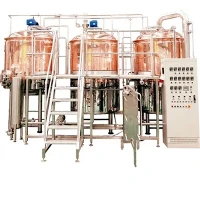
A standard brewhouse system includes several core vessels and auxiliary equipment: the mash tun serves as the main saccharification vessel where milled malt mixes with water under accurate temperature control to complete starch conversion, equipped with stirring paddles to avoid grain deposition and heating jackets or coils for heating and heat preservation; the lauter tun separates spent grain from wort after mashing, fitted with a precision false bottom to filter liquid and a raking device to loosen the grain bed for higher filtration efficiency; the kettle receives clear wort for boiling, which sterilizes the liquid, deactivates enzymes, realizes hop isomerization for bitterness, coagulates excess proteins and evaporates moisture to reach the target wort concentration; the whirlpool tank clarifies boiled wort via vortex centrifugal force to gather trub at the center, while many modern compact brewing lines integrate the kettle and whirlpool into one combined tank; supporting auxiliary equipment covers a hot liquor tank supplying hot water for mashing and sparging, mash pumps for liquid transfer, plate heat exchangers to rapidly cool hot wort to yeast pitching temperature, as well as PLC or computer automatic control systems that regulate temperature, time and all key parameters throughout the whole saccharification procedure.
Detailed Products
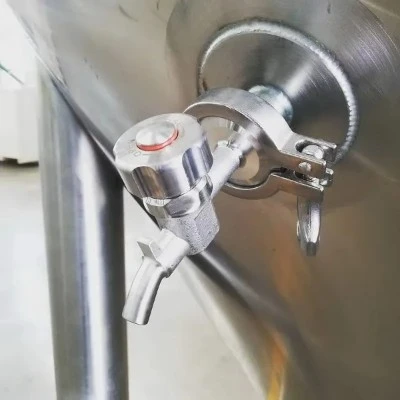

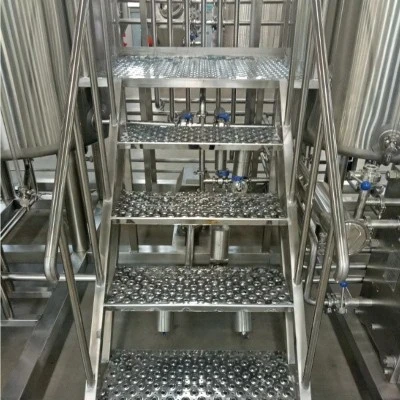

Our brewhouse system comes with practical premium stainless steel accessories for reliable daily operation: hygienic tri-clamp sampling taps are fitted on tank walls to allow quick sterile wort testing at any production stage; non-slip stainless steel access stairways with full handrails offer stable, safe access to high-level equipment for inspection and maintenance; rotary spray balls are included as standard CIP components, which rotate evenly inside all vessels to deliver full-coverage high-pressure cleaning and guarantee complete sanitation throughout every brewing cycle.
Parameter
Brewery Mash System: Technical Parameters & Specifications
This template outlines the key parameters for a standard 3-vessel brewhouse, commonly used in craft breweries.
The values are typical examples for a 10 HL (Hectoliter) batch size.
| Category | Parameter | Specification / Typical Value | Notes / Description |
|---|---|---|---|
|
General System |
System Type | 3-Vessel Brewhouse (Mash Tun, Lauter Tun, Brew Kettle) | Can be 2-vessel (combi) or 4-vessel systems. |
| Batch Size (into Fermenter) | 10 HL (≈ 8.5 US BBL) | Defines the nominal volume of wort produced per batch. | |
| Annual Capacity (Theoretical) | ~2,500 HL (≈ 2,100 US BBL) | Based on 2 batches/day, 5 days/week. | |
| Material of Construction | 304 or 316L Stainless Steel | 316L offers higher corrosion resistance, especially for CIP. | |
| Surface Finish | #4 Brushed / 2B / Mechanical Polish | Affects cleanability and appearance. | |
| Insulation | Cladded Polyurethane or Rock Wool | Prevents heat loss and ensures safety. | |
| Control System | PLC + HMI (Touch Screen) | Allows for automated, repeatable mashing processes. | |
|
Mash Vessel |
Function | Mashing & Protein Rest | Where starch conversion to sugars occurs. |
| Total Volume | 15 HL | Allows for the full volume of grist and water. | |
| Heating Method | Jacket (Steam or Thermal Oil) | Direct fire or electric heating are alternatives. | |
| Agitator | Variable Speed, Scraping Blades | Ensures homogenous temperature and prevents scorching. | |
| Temperature Range | 30°C - 78°C (86°F - 172°F) | Covers all standard saccharification rests. | |
| Temperature Control Accuracy | ±0.5°C (±0.9°F) | Critical for enzyme activity and mash consistency. | |
|
Lauter Tun |
Function | Wort Filtration & Sparging | Separates sweet wort from spent grains. |
| Total Volume | 15 HL | Similar to mash tun to hold the entire mash. | |
| False Bottom Type | Slotted Wedge Wire / Perforated Plates | Must support the grain bed while allowing wort passage. | |
| Openings Area | 8-12% of total false bottom area | Balances flow rate and grain bed stability. | |
| Rakes / Knives | Hydraulic or Electric, 2-Speed | Used to cut and level the grain bed for efficient runoff. | |
| Sparge Arm | Rotating or Oscillating | Evenly distributes sparge water over the grain bed. | |
| Expected Lauteration Time | 60 - 120 minutes | Depends on grist composition and recipe. | |
|
Brew Kettle |
Function | Wort Boiling, Hop Addition, Whirlpooling | For wort sterilization, concentration, and flavor development. |
| Total Volume | 20 HL | Sized to accommodate boil-up (evaporation and foaming). | |
| Heating Method | Jacket (Steam - Internal/External Calandria) | Internal calandria offers high thermal efficiency. | |
| Heating Surface Area | ~6 m² (for 10 HL) | Determines boil vigor and heating speed. | |
| Boil Intensity / Evaporation Rate | 4 - 8% per hour | Affects hop utilization and wort concentration. | |
| Whirlpool Function | Tangential Inlet & Whirlpool Arm | Creates a trub cone in the center for clarified wort. | |
| Whirlpool Rest Time | 20 - 30 minutes | Standard settling time for trub. | |
|
Performance & Utilities |
Thermodynamic Cycle | Full or Re-cuperated | Recuperative systems pre-heat water using waste steam. |
| Steam Pressure Requirement | 4 - 6 bar (60 - 90 psi) | Common requirement for thermal fluid is ~300°C. | |
| Water Consumption (per HL beer) | 3 - 5 HL | Includes brewing, cooling, and cleaning. | |
| Power Supply | 400V / 3-Phase / 50Hz | Standard for industrial equipment. | |
| CIP (Clean-in-Place) | Integrated CIP System | Automated spray balls and pump for cleaning vessels. | |
| Brewhouse Yield | 78% - 85% | Efficiency of extracting sugars from the malt. |
Production of Brewing Equipment

Packing & Shipping

Certificate

Customer Review

Hot Tags: commercial brewhouse system, China commercial brewhouse system manufacturers, suppliers, factory