


Brewery Control Cabinet
This is a brewery-specific point-type temperature control cabinet, which falls into the "single-loop/point-type control system" we discussed earlier. It is an entry-level automatic control device for small craft breweries.
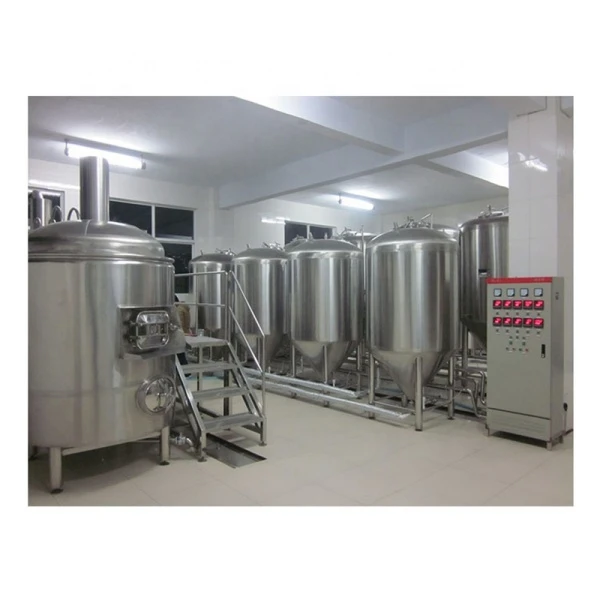
Core Function:It is an independent "one-to-one" temperature control cabinet. Each set of digital display meters and buttons on the panel corresponds to controlling the temperature of one tank (e.g., a mashing tun or fermentation tank). You can manually start/stop heating or cooling equipment via the buttons, and the digital meters will display the real-time temperature of the tank.
Core Structure of Brewery Control Cabinet
Digital Temperature Meters: There are 15 digital meters on the front, one for each tank. You can see the current temperature and set your target right on the meter-like setting a fermentation tank to 8℃.
Control Buttons: The green button under each meter starts or stops the heating/cooling for that tank. The big red emergency stop button cuts power to the whole cabinet if something goes wrong.
Main Power Switch: The red-and-white switch on the side is the main power switch-use it to turn the entire cabinet on or off.
Cooling Fan: The fan at the top left keeps the inside of the cabinet cool, so the electronics don't overheat when running all day.
Other Types of Control Cabinets
In addition to the point-type temperature control cabinet and centralized PLC control cabinet mentioned earlier, there are three other types of control cabinets tailored to meet the needs of breweries at different development stages and with different operational requirements.


1. Modular PLC Temperature Control Cabinet (Transition Model from Point-type to Full PLC Cabinet)
Semi-centralized control: 3-5 core fermentation tanks plus 1 mashing system are precisely temperature-controlled by a compact PLC cabinet (with basic PID regulation), while the remaining tanks use independent temperature gauges. It balances precision control for core processes and budget savings, making it an ideal choice for phased automation upgrades.
2. Split-type PLC Control Cabinet (Custom Model for Decentralized Workshop Layouts)
A split design of the centralized PLC cabinet, consisting of 1 main cabinet (installed in the central control room) and multiple on-site sub-control boxes (mounted near tanks). It enables on-site tank control to solve signal issues caused by large workshops and long wiring distances, with the same full-process PID regulation and equipment interconnection functions as a standard centralized PLC cabinet.
3. Integrated PLC Control Cabinet (High-end Model for Full-process Automation)
Upgraded from the basic centralized PLC cabinet, integrated with frequency conversion control, data collection and remote monitoring functions. Boasts PID temperature control precision within ±0.2℃, supports precise flow regulation, automatic production data storage/export, and remote workshop monitoring/parameter adjustment. It also interconnects all auxiliary equipment (CIP cleaning, refrigeration units, filling lines, etc.) for fully unmanned brewing process control.
Difference from PLC Control Cabinets:
This one controls each tank completely on its own-there's no connection between them, so it can't do things like automatically ramp up the temperature for mashing or release pressure in fermentation tanks by itself.A centralized PLC cabinet, however, lets you control all your tanks from one place, automates the whole brewing process, and keeps temperatures super steady with PID adjustment. It's the best step up if you want to grow your brewery.

Technical Parameter of Brewery Control Cabinet
The following are the technical specifications for the Modular PLC Temperature Control Cabinet (Point Control Cabinet), the Distributed PLC Control Cabinet, and the Integrated PLC Control Cabinet, respectively
Point Control Cabinet (Basic Level)
| Category | Specification | Details for Brewery Application |
|---|---|---|
| Model Number | BTC-POINT-01 | Brewery Temperature Point Control |
| Design Concept | Individual temperature zone control | One PID controller per fermentation/brite tank |
| PLC Configuration | Micro PLC or temperature controller with basic I/O | Siemens S7-1200 Basic or dedicated temperature controller |
| Temperature Zones | 1-4 independent zones | Typically 1 zone per tank |
| Control Points | 8-16 digital I/O maximum | For basic pump/valve control |
| HMI Interface | Local digital display or small 4" HMI | Simple setpoint adjustment and temperature display |
| Communication | Basic Modbus RTU or none | Local operation only, no central monitoring |
| Power Supply | 120/230VAC single phase | For individual tank control |
| Typical Application | Small brewhouse, pilot systems, single tank control | Fermentation temperature control only |
| Enclosure Size | 400×500×200mm (compact) | Wall-mounted near tank |
| Cooling Capacity | 1-2 refrigeration circuits | Direct expansion or glycol control |
| Alarm Functions | Basic high/low temperature alarms | Local buzzer or light |
| Integration | Standalone operation | No network connectivity |
| Cost Level | Low | Entry-level solution |
| Typical Brewery Use | Nano-breweries, individual tank retrofits, pilot brewing systems |
Distributed PLC Control System (Intermediate Level)
| Category | Specification | Details for Brewery Application |
|---|---|---|
| Model Number | BTC-DIST-02 | Distributed Brewery Control System |
| Design Concept | Master PLC with remote I/O stations | Central control with distributed temperature zones |
| PLC Configuration | Main PLC (S7-1500/ControlLogix) + remote I/O racks | Central processor with PROFINET/ EtherNet IP remote racks |
| Temperature Zones | 8-32 zones (expandable) | Multiple fermentation tanks, bright tanks, CLT control |
| Control Points | 64-256 digital I/O, 16-64 analog I/O | Complete brewhouse control including pumps, valves, level sensors |
| HMI Interface | Central 15" HMI + local panel views | Full visualization of entire brewery process |
| Communication | Industrial Ethernet (PROFINET/EtherNet IP) | Networked system with remote I/O drops |
| Power Supply | 400VAC 3-phase + 24VDC distributed | Separate power distribution for each area |
| Typical Application | Medium-sized craft breweries (10-50 BBL) | Complete brewhouse and cellar control |
| Cabinet Layout | Main control cabinet + satellite panels | Satellite panels near tank farms |
| Cooling Capacity | Multiple refrigeration circuits with coordinated control | Glycol system with zone valves, compressor sequencing |
| Alarm Functions | Comprehensive alarm management with acknowledgment | SMS/email alerts, historical alarm logging |
| Integration | OPC UA server, Modbus TCP for third-party equipment | Integration with boiler, chiller, lab equipment |
| Data Logging | Batch recording, trend data storage | Recipe management, fermentation tracking |
| Typical Brewery Use | Complete brewhouse automation, multi-tank fermentation control, CIP system integration |
Integrated PLC Control System (Advanced Level)
| Category | Specification | Details for Brewery Application |
|---|---|---|
| Model Number | BTC-INTEG-03 | Integrated Brewery Automation System |
| Design Concept | Fully integrated control with redundant components | Complete brewery automation including all processes |
| PLC Configuration | Redundant PLC system (S7-1500H/ControlLogix Redundant) | Hot standby with automatic failover |
| Temperature Zones | 32-128 zones with cascade control | Complex multi-zone control with energy optimization |
| Control Points | 256-1024 digital I/O, 64-256 analog I/O | Entire plant including utilities, packaging, warehouse |
| HMI Interface | Multiple HMIs + SCADA system + mobile access | Siemens WinCC Advanced/FactoryTalk View SE |
| Communication | Plant-wide industrial Ethernet with fiber backbone | PROFINET, EtherNet/IP, OPC UA, MQTT |
| Power Supply | Dual redundant power supplies with UPS backup | 400VAC 3-phase with automatic transfer switch |
| Typical Application | Large production breweries (100+ BBL) | Full plant automation from raw material to finished product |
| Cabinet Layout | Main control room with multiple cabinets | NEMA 4X/ IP66 rated for harsh environments |
| Cooling System | Advanced refrigeration control with predictive algorithms | Multi-compressor systems, free cooling integration |
| Alarm Functions | Advanced alarm management with root cause analysis | Alarm suppression, dynamic prioritization |
| Integration | Full MES integration, ERP connectivity, cloud analytics | Batch reporting, quality management, maintenance scheduling |
| Data Management | SQL database, batch historian, electronic batch records | FDA 21 CFR Part 11 compliance (if applicable) |
| Redundancy | Fully redundant: PLC, network, servers, power | 99.9% system availability |
| Security | Industrial cybersecurity with defense-in-depth | User role management, audit trails, network segmentation |
| Typical Brewery Use | Large-scale production facilities, multi-plant operations, facilities requiring regulatory compliance |
Advanced Production Equipment
Critical Role of Professional Equipment in Brewery Control Cabinet

Laser Cutting Machine
Laser cutting machine is a modern CNC machine tool that utilizes a high-power-density laser beam to perform non-contact precision cutting of materials (typically metals). In the production of Brewery Control Cabinet and other industrial control cabinets, it directly translates design drawings (such as CAD files) into physical parts by precisely cutting complex-shaped openings on the cabinet's door panels, side panels, top covers, and mounting plates (back panels) in a single operation. This level of precision ensures that all components are installed in their exact positions without error.

CNC Press Brake
In the manufacturing of brewery control cabinets, the CNC press brake undertakes core forming tasks, specifically fulfilling four major functions:
Forming the Cabinet Frame
It precisely bends laser-cut side panels, top, and base plates at 90-degree angles to construct a square and robust external frame.
Reinforcing the Door Structure
It presses reinforcing ribs and flanges along the edges of door panels, enhancing rigidity and ensuring a tight seal to meet dust and waterproof requirements.
Processing Electrical Mounting Plates
It bends vertical backplates used for mounting PLCs, circuit breakers, and other components, with flatness precision ensuring accurate positioning of all elements.

Polishing Machine
The application of polishing machines in the production of Brewery Control Cabinets is crucial. For example:
Cabinet Surface
Mirror polishing / Brushed polishing eliminates microscopic surface pits.
The smooth surface leaves no hygiene dead corners, complying with food industry hygiene standards (e.g., EHEDG).
Weld Seams
Weld polishing / Deburring polishing ensures smooth, clean seams.
Brand Image
A control cabinet with a mirror-grade stainless steel appearance visually conveys a brand image of "high quality, precision, and attention to detail."
Controlling System:Application Scenarios Across Different Brewing Equipment
Brewery Control Cabinet in Craft Beer Pub
This is a small craft brewery scenario. This control cabinet is a floor-standing model characterized by its compact footprint and equipped with wheels for easy mobility. In a tight brewery space, it can be temporarily moved aside for floor cleaning, equipment maintenance, or layout adjustments. It may be positioned next to the brewhouse system without permanent fixation, offering maximum layout flexibility. It is likely designed as a central mobile control station, allowing the brewer to roll it to the brewhouse area for brewing operations, then to the fermentation tank area for temperature checks, or even to the packaging zone for use.
CIP System with Control Cabinet
The image depicts the control panel integrated into a three-vessel CIP (Clean-in-Place) station within a brewery system. It is directly mounted onto the frame or module of the CIP unit, forming a complete cleaning assembly together with tanks, pumps, valves, piping, and instrumentation. The panel features a touch-screen interface specifically designed for selecting cleaning programs-such as acid wash, caustic wash, hot water rinse, and sterilization (SIP)-setting parameters like time, temperature, and concentration, and displaying process steps and alarms in real time

Core Protection Objectives for the Brewery Control Cabinet
Impact and Vibration Protection: To prevent the Brewery Control Cabinet from deformation, damage to door hinges, and loosening or detachment of internal electrical components.
Moisture and Humidity Protection: To prevent rust on the Brewery Control Cabinet structure, safeguard electrical parts from dampness, and stop labels from peeling off in humid brewery environments.
Dust and Contamination Protection: To maintain the hygiene and cleanliness of the Brewery Control Cabinet, which is critical for food-grade production areas.
Clear Identification: To ensure the Brewery Control Cabinet is handled correctly and with care throughout the entire logistics chain.

CERTIFICATION
To certify that the product complies with a series of EU legal requirements (Directives) concerning safety, health, environmental protection, and consumer protection.
The Two Most Critical Directives for Control Cabinets:
Low Voltage Directive (LVD): Ensures the safety of electrical equipment within its rated voltage range (protection against electric shock, fire, mechanical hazards, etc.).
Electromagnetic Compatibility (EMC) Directive: Ensures that the equipment's own electromagnetic emissions do not interfere with other devices, while also enabling it to withstand electromagnetic interference from the environment.


When you purchase a Brewery Control Cabinet, an SGS certificate essentially serves as hiring a "globally recognized authoritative referee" for you.
Component Authenticity Verification: The SGS report can verify whether the PLCs, circuit breakers, and other components inside the cabinet are genuine products from top-tier brands such as Siemens or ABB, preventing the use of inferior substitutes.
Process Standard Certification: It confirms whether the wiring, grounding, insulation, and other aspects comply with industrial safety standards such as IEC 60204-1, ensuring that the Brewery Control Cabinet can withstand the humid, corrosive cleaning environments typical of breweries.

Q&A
Q1:How does the level of automation in a control cabinet match the scale of my brewery?
A1: Recommended configurations based on scale:
Small Craft Brewery (<1,000L/batch): Compact PLC + touchscreen interface, enabling basic automated temperature control and pump/valve sequencing.
Medium Brewery (1,000–5,000L/batch): Mid-range PLC + SCADA system, supporting multi-tank coordination, recipe management, and data logging.
Large Production Brewery (>5,000L/batch): Distributed Control System (DCS) or redundant PLCs, integrated with energy management, MES interfaces, and full-plant monitoring.
Q2: What is your lead time, and do you offer onsite commissioning?
A2: Standard cabinets: 6-8 weeks from order to shipment, including design, assembly, and testing.
Customized projects: 10-14 weeks, depending on complexity.
Onsite services: Yes, we provide global commissioning support. Our engineers can travel to your site for installation guidance, startup, and operator training. Travel costs are quoted separately.
Q3: Will the control cabinet malfunction in humid environments (e.g., near a CIP station)?
A3: We address the humid and corrosive conditions typical in breweries through a "Triple-Layer Protection" approach:
Cabinet Protection:
Standard IP65 rating (dust-tight and protected against water jets), with food-grade sealing gaskets on the door.
Internal Climate Management:
Equipped with a built-in anti-condensation heater and a temperature/humidity controller for automatic regulation, preventing condensation entirely.
Materials and Craftsmanship:
Electrical components are coated with conformal coating, and terminals are made of gold-plated or corrosion-resistant materials. For extreme environments, we offer full stainless steel enclosures (316L) as an option.
Q4: Can you provide a "turnkey" project, covering everything from design to installation and commissioning?
A4: Yes, we offer a comprehensive "Concept to Production" full-process service:
Preliminary Design:
Based on your process flow diagram, we provide electrical schematics, cabinet layout drawings, and simulation models.
Production and Testing:
Assembly, wiring, and comprehensive factory acceptance testing (FAT) are completed in our facility.
On-Site Implementation:
We dispatch engineers for on-site installation guidance, wiring verification, power-up debugging, and process integration.
Training and Handover:
We provide systematic training for your operators and maintenance personnel until they can operate independently.
Service Scope:
Depending on your needs, our services can cover all electrical automation aspects of the workshop, starting from the control cabinet.
Q5: What brands of PLCs and touchscreens are used in the control cabinet? Are they compatible with our existing equipment?
A5: We primarily offer the following two configuration solutions:
International Brand Solution:
Siemens PLC + Siemens/Weinview touchscreen – This system is stable, backed by a mature ecosystem, and has extensive after-sales service networks.
Cost-Effective Solution:
Delta/Inovance PLC + Kinco/McgsPro touchscreen – Reliable performance, more cost-effective, and widely used in the food and beverage industry.
Compatibility Assurance:
Before contract signing, we conduct an "Interface Audit" to verify the communication protocols (such as Modbus, PROFIBUS) and signal types of your existing equipment. If needed, we can integrate protocol gateway modules to ensure seamless compatibility. We commit to "no compatibility, no shipment."
Exhibition
From the perspective of a client (such as a brewery investor, chief engineer, or procurement manager), seeing and operating a swing-arm control cabinet in person at an exhibition holds far greater significance than reading a product manual. This encounter is, in essence, a process of "immersive capability assessment" and "risk pre-elimination." Visitors to the exhibition can intuitively observe the quality and craftsmanship of the equipment. Coupled with technical explanations from our engineers, this further enhances their trust. It is far more direct than communicating through a computer screen, though initial remote communication remains the foundation of trust. Through exhibitions, we enable clients from around the world to learn about and recognize us, allowing our equipment to reach international markets.

Hot Tags: brewery control cabinet, China brewery control cabinet manufacturers, suppliers, factory, Single Tank Temperature Controller


