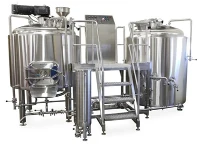
2 Vessels Beer Brewhouse
A two-vessel brewhouse represents a standard dual-unit professional brewing setup, also known as dual-pot mashing equipment. This compact system completes all four core brewing workflows-mashing, lautering, boiling and whirlpool sedimentation-by leveraging two versatile multi-functional tanks. This configuration comes in multiple mainstream layouts; the most prevalent design assigns mashing and boiling duties to one tank while the second takes care of lautering and whirlpool separation, with an alternative arrangement swapping the tank functions to combine mashing and lautering in one vessel and boiling alongside whirlpooling in the other, both schemes centering on maximizing the multi-purpose functionality of each tank to cut down equipment footprint.
Core Structure of 2 Vessels Beer Brewhouse
Core Structure:
Jacket & Heating System: Features a full-cladding jacket with an efficient coil heating system, enabling precise step temperature control (±0.5°C accuracy).
Agitator: Equipped with a variable frequency drive (VFD) agitator. This ensures uniform mash mixing and efficient heat transfer while preventing disruption of the grain bed during lautering.
Filtration System: The bottom is fitted with milled false plates/screens to form a stable filter bed, enabling fast and high-extraction wort runoff.
Sparging System: Incorporates a 360-degree rotating spray ball for even hot water distribution during sparging, maximizing sugar extraction.
2. Multi-Purpose Boil/Whirlpool Kettle
Function Integration: Receives the wort post-filtration to sequentially perform boiling and whirlpooling.
Core Structure:
High-Capacity Heating System: Utilizes a high-power steam jacket or internal electric heating elements to ensure the wort reaches and maintains a vigorous rolling boil within the specified time, promoting protein coagulation and DMS volatilization.
Hop Addition Port: Features a sealable, screw-cap hop port for precise hop additions at different stages of the boil.
Whirlpool Design: The kettle bottom is designed as a cone or flat bottom with a central drain. After boiling, wort is pumped tangentially into the kettle to create a powerful vortex. This forces hot break material (hop debris, coagulated protein) to form a compact trub cone in the center, enabling highly effective primary wort clarification.


Technical Parameter of 2 Vessels Beer Brewhouse
The following table provides a detailed technical comparison of standard two-vessel brewhouse systems in the classic "Mash/Lauter Tun + Boil/Whirlpool Kettle" configuration. Specifications are based on typical 500-liter (0.5 HL) and 1000-liter (1 HL) batch capacities, highlighting the key scaling differences for medium and small-scale craft breweries.
| Category | Parameter | 500L Brewhouse System | 1000L Brewhouse System |
|---|---|---|---|
| System Overview | Standard Batch Output | 500 L of hot wort | 1000 L of hot wort |
| Primary Application | Craft beer bars, startup breweries, pilot systems | Small commercial breweries, expanding craft operations | |
| Control Core | PLC with touchscreen HMI; Full-auto/Manual modes | ||
| Product Contact Material | AISI 316L Stainless Steel, sanitary polish | ||
| Mash/Lauter Tun | Total Volume | 800 - 1000 L | 1500 - 1800 L |
| Heating Method | Partial or full jacket, often with auxiliary coil | Full jacket, typically with zoned temperature control | |
| Heating Medium/Power | Electric: 60 - 80 kW Steam: 0.3-0.6MPa (Optional) |
Electric: 120 - 150 kW Steam: 0.6MPa (Typical) |
|
| Temp. Control Accuracy | ± 0.5 °C | ± 0.5 °C | |
| Agitator | Top-mounted, Variable Frequency Drive (VFD) | Side- or top-mounted, VFD with higher torque | |
| False Bottom/Screen | Milled false plates, slot width 0.7-1.0 mm | ||
| Kettle/Whirlpool | Total Volume | 700 - 800 L (accounting for boil-up) | 1200 - 1400 L (accounting for boil-up) |
| Heating Method | Steam jacket or internal electric elements | Steam jacket (standard) or high-power electric | |
| Heating Power/Consumption | Electric: 72 - 96 kW Steam: ~150 kg/h |
Electric: 150 - 180 kW Steam: ~250-300 kg/h |
|
| Boil-off Rate | 8-10% per hour | 8-12% per hour | |
| Whirlpool Design | Flat or shallow cone bottom, tangential inlet | Shallow cone bottom, tangential inlet (more stable vortex) | |
| Hop Ports | 1-2 sanitary Tri-Clamp ports | 2 sanitary Tri-Clamp ports | |
| Pumps & Piping | Wort Transfer Pump | Sanitary centrifugal pump, capacity ~5,000 L/h | Sanitary centrifugal pump, capacity ~10,000 L/h |
| CIP Pump | Dedicated centrifugal pump | ||
| Piping & Valves | AISI 316L SS pipes, sanitary Tri-Clamp fittings, pneumatic diaphragm valves | ||
| Utilities (Est.) | Total Electrical Load | 40 - 60 kW (higher peak if all-electric) | 70 - 100 kW (higher peak if all-electric) |
| Water per Batch | 1,200 - 1,800 L (brewing, cooling, cleaning) | 2,000 - 3,000 L (brewing, cooling, cleaning) | |
| Compressed Air | 0.6-0.8 MPa, low consumption | 0.6-0.8 MPa, moderate consumption | |
| Physical Dimensions | Footprint (L x W) | Approx. 3.5m x 2.5m (excl. periphery) | Approx. 4.5m x 3.5m (excl. periphery) |
| Installation Height | Approx. 3.2 - 3.5m | Approx. 4.0 - 4.5m |
Advanced Production Equipment
Critical Role of Professional Equipment in Beer Brewhouse
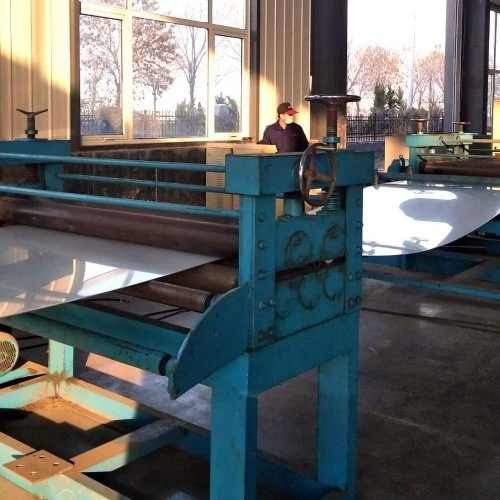
Uncoiling and Cutting Line
The cylindrical body of the mashing kettle is manufactured by roll-forming and welding food-grade stainless steel plates, such as the high-quality 316L stainless steel you mentioned. These steel plates are typically pre-processed into coils at the factory for ease of transportation and storage. The uncoiler shown in your image serves as the first critical piece of equipment on the production line, tasked with smoothly and precisely unwinding the coiled steel plates to prepare them for accurate cutting and subsequent shaping.

Laser Cutting Machine
The laser cutting machine is an indispensable "precision tailor" in modern brewhouse equipment manufacturing. It precisely transforms design drawings into physical parts, ensuring accuracy, efficiency, and consistency from the very first step. It accurately cuts the unfolded shapes of steel plates for forming cylinder bodies, cone bottoms, and heads.
Its key advantage lies in functional cutouts: brewhouse vessels feature numerous ports such as manholes, sight glasses, temperature/pressure sensor fittings, CIP spray ball openings, and agitator mounting points.

Cone Rolling Machine
In the production of a beer mashing kettle, its primary role is to form the kettle's conical bottom section. The (pie-shaped plate) is fed into the cone rolling machine. Through the synchronized, progressive pressure and rotation of its rollers, the flat plate is gradually and uniformly shaped, ultimately being formed into a precise conical cylinder.
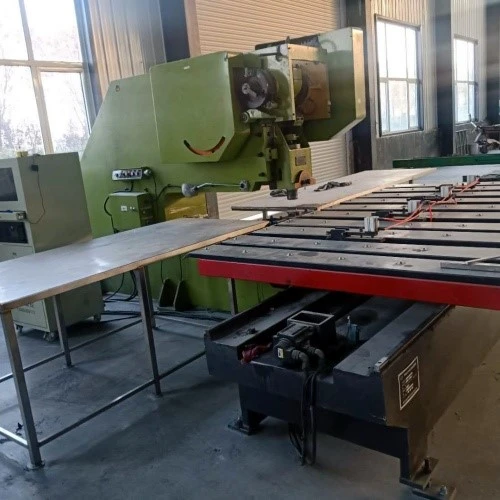
Punching Machine
It efficiently and completes the punching of standardized holes and the forming of specific components.
In the manufacturing of mashing kettles, it is used to process a large number of standardized bolt holes on the kettle body or heads. For example, mounting holes for fixing manhole covers, agitator flanges, sight glass flanges, and various instrument connection flanges. Stamping is far more efficient than laser-cutting these circular holes individually.
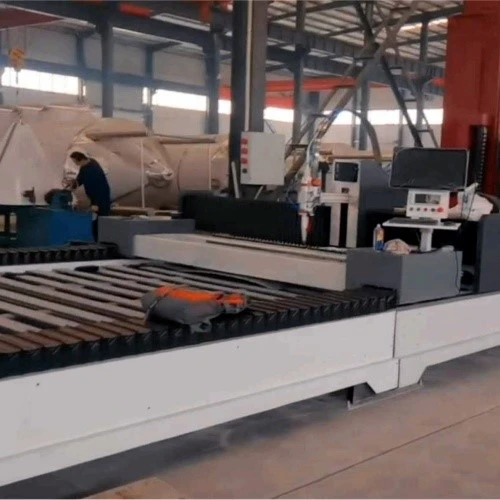
Fully Automatic Laser Welding Machine
It achieves ultra-high precision, deep-penetration welding with minimal distortion, excelling particularly in thin-sheet joining and precision component welding. This technique is used to join inside the mashing kettle, such as CIP spray ball branches, temperature sensor sleeves, and similar internal fittings.

Robotic Automatic Welding System
It replaces manual labor to complete long welds and repetitive welds with extremely high stability and consistency.
In the manufacturing of mashing kettles, it welds the longitudinal seam of the rolled cylindrical shell and the circumferential seam connecting the head to the shell. These welds are lengthy, require high pressure resistance, and must be absolutely leak-proof. Robotic welding ensures that the speed, current, and angle remain perfectly consistent along the entire weld seam.
Attachment Welding: It welds external structural components such as support legs, platforms, ladders, and insulation support rings.

Polishing Machine
The polishing machine serves as the essential "cosmetologist" in the manufacturing process of brewhouse equipment (such as mashing kettles, lauter tuns, and boil kettles). This is the most critical area for polishing. The entire interior surfaces of the mashing kettle, lauter tun, and boil kettle must undergo comprehensive,死角-free polishing to ensure that all surfaces in contact with wort, steam, and cleaning agents achieve a sanitary-grade finish.
Weld Seam Areas: All internal and external weld seams undergo focused polishing to make them flush and smooth with the base material.
Brewhouse System:Application Scenarios Across Different Brewing Scales
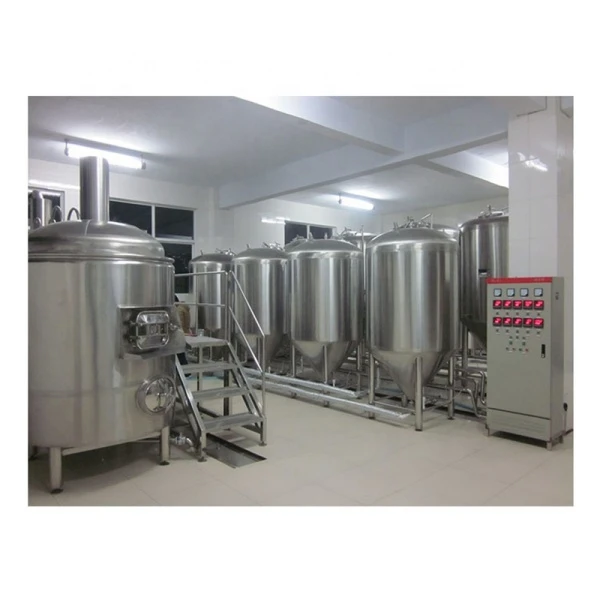
2 Vessels beer Brewhouse System in the Brewpub
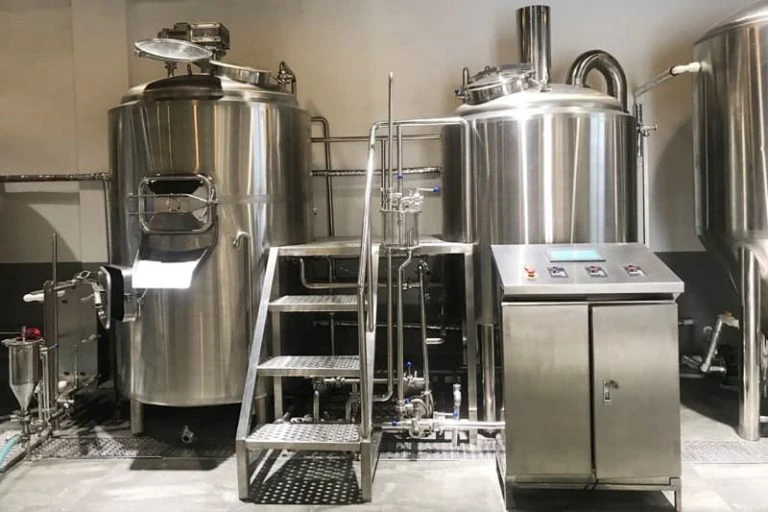
The image shows a brewing system installed in a craft beer bar. This 1000L two-vessels setup combines mashing and boiling functions, featuring a top lauter tun and a bottom whirlpool configuration. Additionally, based on the client's beer variety and brewing process requirements, the system is equipped with 1000L 8 fermentation tanks. The layout is highly compact, maximizing space efficiency, while the piping connections are clean and streamlined.
Beer Brewhouse Large-Scale Breweries
As can be seen in the image, there is a set of 5–10 ton mashing equipment. Compared to the small two-vessel mashing systems used in bars and brewpubs, the mashing equipment in large-scale breweries places greater emphasis on efficiency, stability, and consistency. The typical mashing configuration consists of four vessels, five vessels, or even more. Additionally, there are higher requirements in terms of automation.

Key Considerations for Packaging and Shipping of Beer Brewhouse
Valves and instruments require robust anti-vibration protection. For instance, they should be fully wrapped with stretch film and bubble cushioning materials. All tank surfaces must be completely sealed with anti-corrosion film. Irregularly shaped equipment should be secured on customized transport bases and internally reinforced with supports to prevent deformation during transit.
Prior to shipment, comprehensive verification of height and weight restrictions along the route is essential. All necessary documentation for customs clearance, sea freight, and transport insurance must be prepared in advance. Equipment arrival schedules must be precisely coordinated with on-site crane availability and installation team readiness to ensure seamless operations.

Our Case
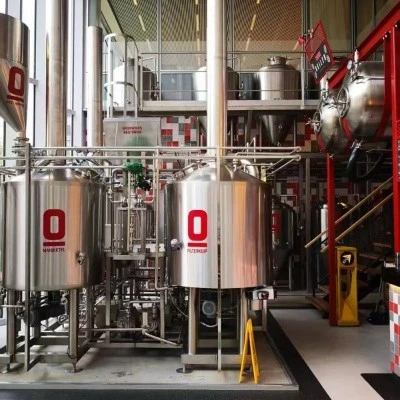
This is a craft beer pub project in the Netherlands. It features a typical two-vessel brewhouse configuration, along with 6 to 8 fermentation tanks and two horizontal bright beer tanks.Brewhouse system like Lauter/ Mashing tun+kettle+whirlpool.
Craft beer taverns require brewing equipment with a compact footprint and highly flexible operation.
This four-vessel brewhouse system serves a craft brewery project in Thailand with an annual capacity of 20 tons. The configuration includes separate vessels for mashing, lautering, boiling, and whirlpooling. It enhances production efficiency and stability while ensuring the consistent quality and flavor of the beer.


This four or five-vessel brewhouse system serves a craft brewery project in Xinjiang with an annual production capacity of 30,000 tons.It must be efficiently connected to large, multi-group fermentation tank clusters via a pipeline network, placing extremely high demands on the automation and speed of the CIP (Cleaning-in-Place) system.
CERTIFICATION


Q&A
Q1: What is the main difference between a 2-vessel and a 3-vessel brewhouse?
A1:The two-vessel system combines the mash tun and lauter tun into a single vessel (mash/lauter tun), with the boil kettle and whirlpool serving as the second vessel. Alternatively, another configuration combines mashing and boiling in one vessel, while the other vessel is designed as a stacked structure-with lautering on top and whirlpool settling below. Both configurations save space and reduce costs, making them suitable for small craft breweries with limited floor space. In contrast, the three-vessel system dedicates one vessel to mashing, another to lautering, and a third shared vessel for boiling and whirlpool functions, making it more suitable for commercial-scale breweries.
Q2: Do you offer installation supervision and training?
A2:Yes. Our engineers will provide on-site equipment installation, commissioning, operational guidance, and hands-on brewing training to ensure smooth production.
Q3: Is the equipment compliant with international standards?
A3: Yes, all our systems are fully certified with EU CE safety compliance (including specialized PED certification for pressure equipment) and strictly adhere to EHEDG hygienic design standards. Third-party inspection reports (e.g., from SGS) are available upon request for verification.
Q4: What after-sales support do you provide?
A4: We offer a one-year warranty on our equipment, ensuring reliable production quality and peace of mind. At the same time, we have established a comprehensive support system covering the entire lifecycle of the equipment: in addition to unlimited technical consultation, we also maintain an efficient spare parts supply chain, with routine requests typically responded to within 48 hours.
Q5: Can the system be customized for our brewery layout?
A5: Certainly. We can adapt the layout, vessel orientation, and control panel placement to your site conditions, while the modular design ensures greater configuration flexibility.
Q6: What control system do you use? Is it automated?
A6:We primarily offer customized control solutions tailored to the specific needs of our clients, encompassing three modes: manual control, PLC-based semi-automatic control, and fully automatic control.
Q7: What materials are used for product contact surfaces?
A7: All surfaces in contact with materials are made of 304 or 316L stainless steel, with weld seams polished to a surface roughness of Ra ≤ 0.8 μm, meeting brewing hygiene requirements.
EXHIBITION SHOW
Anti-shake and high stabili

Participating in international trade shows brings our workshop directly to the doorstep of global clients. When customers touch the solid stainless steel of our mashing tanks and witness the automated brewing processes on the control screen, the specifications once confined to blueprints transform into tangible, reliable quality they can feel firsthand. Even when language barriers exist, experienced brewers recognize at a glance that we speak their technical language.
Ultimately, exhibiting isn't just about securing orders-it's about demonstrating to the world that brewing equipment made in China is equally trustworthy and dependable.
Hot Tags: 2 vessels beer brewhouse, China 2 vessels beer brewhouse manufacturers, suppliers, factory, sustainable brewing system, boil kettle, custom brewhouse system, mobile brewing system, mash tun, brewing proteins