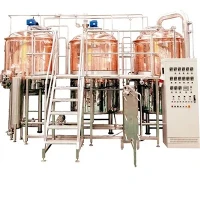
4 Vessels Brewhouse System
The 4-Vessel Brewhouse System is a professional commercial brewing system consisting of a mash tun, lauter tun, brew kettle, and whirlpool tank, suitable for the continuous production needs of medium to large-scale craft breweries. Each tank takes charge of one standalone brewing stage, eliminating cross-process waiting and enabling parallel operations. The mash tun maintains precise temperature curves for full starch conversion, while the dedicated lauter tun delivers steady wort filtration and high grain extract yield. The brew kettle supports intensive rolling boil to evaporate unwanted volatiles and infuse hop flavors, and the whirlpool tank neatly gathers hot trub and hop residues for clean, clear wort before cooling. This layout greatly boosts daily brewing batches and ensures consistent flavor across every run. All contact surfaces adopt food-grade polished stainless steel, compatible with semi-auto or full PLC automatic control. Its modular structure also leaves room for capacity expansion as brewery output grows, making it a long-term stable pick for expanding craft beer brands.

Advantage
High Production Efficiency
Multiple vessels can run different processes simultaneously, reducing waiting times and significantly increasing output per unit of time, making it suitable for commercial continuous production.
Independent and Stable Process
Four separate vessels handle mashing, filtration, boiling, and whirlpool processes, avoiding process interference and ensuring repeatable control of key parameters for batch consistency.
High Wort Clarity
The independent filtration tank, combined with the whirlpool structure, effectively separates spent grains, protein coagulates, and hop residues, providing clear wort for high-quality fermentation.
Flexible Recipe Switching
Supports multi-stage mashing programs and multiple hop additions, facilitating switching between different beer styles and meeting the needs of multi-product production.
Suitable for Scalable Expansion
The system has a mature structure and can be integrated with larger capacity fermentation tanks and automated control systems, reducing the cost of future expansion and modifications.
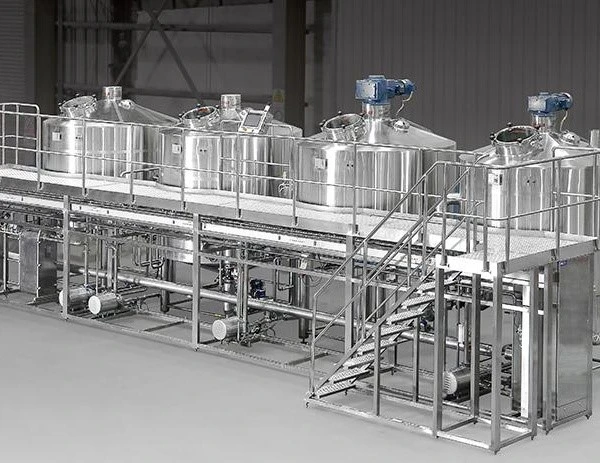
Specifications & Parameters
| Vessel | Key Configuration | Key Process Parameters |
|---|---|---|
| Mash Tun |
- Heating Method: Steam jacket (most common), electric heating elements, direct fire - Agitator/Mixer: Variable speed motor with stirring paddles - Temperature Sensor: PT100 precision probe - Insulation: Cladding with mineral wool or other insulation material - CIP (Clean-in-Place): Spray ball for internal cleaning |
- Mash Thickness: 1:2.5 to 1:5 (Water to grist ratio, L/kg) - Rest Temperatures & Times: - Acid Rest: 35-45°C (95-113°F), 10-30 min (rarely used) - Protein Rest: 45-55°C (113-131°F), 10-20 min - Beta-Amylase (Saccharification) Rest: 62-67°C (144-153°F), 30-60 min - Alpha-Amylase (Mash-Out) Rest: 75-78°C (167-172°F), 5-10 min - Heating Rate: ~1°C per minute typical |
| Lauter Tun |
- False Bottom/Screens: Slotted plates or screens with precise gap sizes (~0.7-1.0 mm) - Rakes/Knives: Rotating and height-adjustable rakes for loosening the grain bed - Spray Arm/Sparge Arm: For evenly distributing sparge water over the grain bed - Inlet/Outlet: Underlet inlet for gentle transfer, multiple wort draw-off points - CIP: Spray ball |
- Grain Bed Depth: Typically 30-50 cm - Recirculation (Vorlauf): Until wort runs clear (5-15 mins) - Sparge Water Temperature: 75-78°C (167-172°F) - Sparge Rate/Time: Matched to run-off speed; total sparge time ~60-90 mins - Final Run-off Gravity: Aim for >1.008 SG to avoid tannin extraction |
| Brew Kettle |
- Heating Method: Steam jacket (most common), internal/external calandria, direct fire - Boiling System: May have an internal boiling mechanism (e.g., agitator, jet stream) for efficiency - Exhaust/Stack: For vapour venting; may include a heat recovery (Merlin) system - Hop Dosing Ports: Multiple additions possible - CIP: Spray ball |
- Boil Intensity/Evaporation Rate: Typically 4-10% per hour - Boil Time: Usually 60-90 minutes - Hop Addition Times: Bittering (start of boil), Flavour (mid-boil), Aroma (end of boil/whirlpool) - Thermal Load: Controlled to avoid excessive Maillard reactions (e.g., DMS removal) |
| Whirlpool |
- Design: Cylindrical vessel with flat or shallow conical bottom - Inlet: Tangential inlet port to create rotational flow - Outlet: Side outlet positioned above the trub pile - CIP: Spray ball |
- Whirlpool Rest Time: 20-40 minutes - Pumping Speed/Inlet Pressure: Sufficient to create a strong vortex - Trub Cone Formation: Clear, compact pile is the goal - Wort Cooling: Typically begins after the rest period, transferring clear wort through a heat exchanger (plate chiller) to the fermentation vessel. |
Production Flow

Our brewing systems are built on this precision manufacturing line. Large stainless steel coils are loaded onto the uncoiler and fed through precision cutting and forming. Each vessel-mash tun, lauter tun, and boil kettle-is cut, welded, and polished using CNC equipment and manual finishing by experienced technicians. Every step, from raw material to final polish, undergoes in-house quality inspection before leaving the workshop.
Packing and Delivery

Every stainless steel tank is fully covered with heavy-duty clear protective film and fastened onto metal frames or pallets to stop movement while in transit. Fragile key parts including nozzles, valves and gauges get extra foam padding and corner protectors. Each piece comes with clear labels showing handling guidelines, model number, weight and center of gravity.
We choose flatbed or container trucks according to the dimension and weight of your equipment. Loads are balanced properly: bigger tanks are placed low and toward the back, while small accessories are packed separately to prevent crushing. We prepare all export paperwork and can deliver goods to your nominated port, so all vessels reach you in good condition
Hot Tags: 4 vessels brewhouse system manufacturer, China 4 vessels brewhouse system manufacturer manufacturers, suppliers, factory