


This is the predominant design in the modern beer industry and is the standard for large, medium-sized, and most craft breweries.
Advantages:
Efficient Sedimentation & Discharge: Its key advantage is the conical bottom. Yeast, cold trub, and other sediment naturally slide down the tank walls and collect compactly in the cone, allowing for quick and complete removal. This significantly speeds up beer clarification.
Superior CO₂ Retention: The tall tank design creates a low surface-area-to-volume ratio for the liquid. This minimizes the beer's contact with the headspace, helping to maintain stable tank pressure and consistent CO₂ levels-preventing oxidation and ensuring proper carbonation.
Compact Footprint: With a small physical footprint, it allows for vertical expansion, making it an economical choice where floor space is limited or expensive.
Streamlined CIP Cleaning: The conical base ensures that cleaning solutions and waste rapidly collect and drain completely. This enables highly effective automated cleaning-in-place (CIP) cycles with minimal dead zones.
Application
The core application scenarios of the bright Beer Tank
Flavor maturation and purification
This is the most fundamental and important function of the sake bottle.
Diacetyl reduction: This is a crucial step for lager beers and some ale beers. Diacetyl is a compound with buttery, creamy candy-like flavors that is produced during the late stage of primary fermentation. During the cold storage in the keg, the remaining yeast will "reduce" it into a more neutral-tasting substance, thereby purifying the beer flavor.
Volatilization of "green" flavor compounds: Some sulfides or other volatile undesirable flavor compounds present in young beers will gradually volatilize or transform during storage, making the beer taste more round and mature.
2. Clarification and Sedimentation
Yeast sedimentation: In a low-temperature environment, most of the yeast cease their activities and settle to the bottom of the cone, forming a dense yeast sludge. This not only makes the beer clearer but also prevents the yeast from continuing to act and produce undesirable flavors after bottling.
Cold turbidity sedimentation: In the cold, substances such as proteins and polyphenols in the beer will combine to form flocculent precipitates and precipitate out. In the clear beer tank, these cold turbid substances will gradually settle and be discharged from the tank, thereby improving the biological and non-biological stability of the beer (that is, extending the shelf life and preventing turbidity after refrigeration).
3. Carbonation
The astringent taste and foam of beer are inseparable from dissolved carbon dioxide. The sake tank is an ideal place to achieve this goal.
Natural carbonation: A small amount of active yeast continues to ferment the remaining trace sugar in the tank, naturally generating CO₂ and dissolving it into the beer.
Artificial carbonation (forced carbonation): A more common and controllable method is to directly inject food-grade CO₂ into the tank through carbonation stones or carbonation tubes. Under low temperature and pressure conditions, it dissolves into the beer until the required carbonation level is reached.
4. Dry hopping of hops
For modern IPA (especially the turbid IPA) and styles like hop-ale, the clear beer tank is the standard location for dry hopping hops.
Fruit/spice addition: Similar to dry hopping hops, during the fermentation tank stage, fruits, spices, coffee beans and other auxiliary ingredients are added to slowly blend their flavors into the beer.
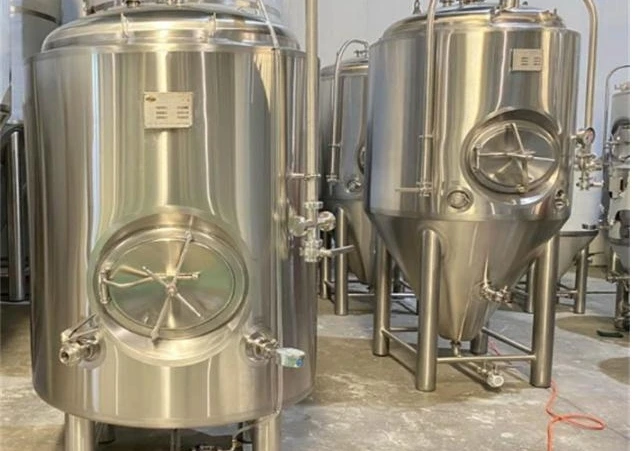

Core functional features
Efficient sedimentation and discharge
Features: Thanks to the conical bottom, impurities such as yeast, hop residues, and condensate will naturally slide down along the tank wall and concentrate and settle in a small area at the bottom of the cone.
Advantages: Short settling path, high efficiency; these sedimentations can be easily and thoroughly removed through the bottom valve, enabling a faster and more thorough clarification process for the beer, with minimal loss of liquid.
Excellent CO₂ retention and carbonation capacity
Features: The tall cylindrical design results in a small ratio of the surface area to the volume of the liquid.
Advantages: This means that the contact area between the liquid and the gas at the top of the tank (headspace) is small, effectively reducing the escape of CO₂, which is beneficial for maintaining the stability of the tank pressure and the dissolution of CO₂ in the liquid, preventing beer oxidation and insufficient carbonation.
Small in floor area and high in space utilization.
Features: Vertical upward development, with a small footprint.
Advantages: In cases where land or factory space is expensive, this is a very cost-effective option, allowing for the installation of large-capacity wine storage equipment within a limited floor area.
Material, structure and interface configuration
Standard: AISI 304 stainless steel, meeting food hygiene requirements.
High standard: AISI 316L stainless steel, with better corrosion resistance, especially suitable for acidic cleaning agents or specific water quality.
Inner wall polishing accuracy
Standard: Internal wall is mechanically polished, with roughness Ra ≤ 0.6 µm.
High standard: Can reach Ra ≤ 0.4 µm or even mirror polishing. The smoother the surface, the less likely it is to accumulate dirt and easier to clean.
Main interfaces
CIP cleaning port: Located on the top of the tank, connected to the rotating cleaning ball.
Material inlet: Located in the middle-upper part of the tank, used for wine input.
Material outlet: Located at the very end of the cone bottom, used for wine discharge and sewage discharge.
CO2 injection/exhaust port: Located on the top of the tank, used for pressure control and carbonation.
Pressure gauge/safety valve port: Located on the top of the tank, used for monitoring pressure and overpressure protection.
Manhole: Located on the top of the tank or the cylinder body, used for maintenance and internal inspection
Parameter
| Category | Parameter | Specification |
|---|---|---|
| General Specifications | Total Volume | 1,000 L |
| Working Volume | 850 L | |
| Design Pressure | 2.0 bar | |
| Test Pressure | 3.0 bar | |
| Cone Angle | 60° | |
| Physical Dimensions | Diameter | 1,100 mm |
| Straight Height | 1,500 mm | |
| Total Height | 2,700 mm | |
| Leg Height | 300 mm | |
| Empty Weight | 350 kg | |
| Material & Finish | Main Material | AISI 304 Stainless Steel |
| Material Thickness | 2.5 mm | |
| Internal Finish | Ra ≤ 0.6 µm | |
| External Finish | #400 Brushed | |
| Insulation | Material | Polyurethane Foam |
| Thickness | 80 mm | |
| Cladding | 304 Stainless Steel | |
| Jacket System | Type | Dimple Jacket |
| Coverage | Cone + Lower Cylinder | |
| Area | 4.5 m² | |
| Design Pressure | 3.0 bar | |
| Connections | 1.5" Tri-Clamp | |
| Standard Connections | CIP Inlet | 2.0" TC (with Spray Ball) |
| Product Inlet | 2.0" TC | |
| Product Outlet | 2.0" TC (Butterfly Valve) | |
| CO₂ Inlet | 1.5" TC | |
| Pressure Relief Valve | 1.5" TC (1.8 bar) | |
| Pressure Gauge | 0-2.5 bar, 1.5" TC | |
| Sample Valve | 1.5" TC (Diaphragm Valve) | |
| Manway | DN400 | |
| Temperature Probe | NPT 1/2" | |
| Vent/CIP Outlet | 2.0" TC |
Production of Brewing Equipment

Packing & Shipping

Certificate

Customer Review

Hot Tags: vertical bright beer tank, China vertical bright beer tank manufacturers, suppliers, factory


