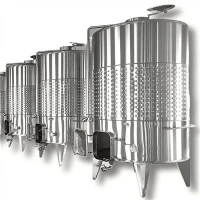
These SUS304 stainless steel wine fermentation tanks feature a dimpled cooling jacket on the exterior for precise temperature control during grape must fermentation. Each tank is fitted with a vertical level gauge, pressure gauge, side manhole for easy cleaning and inspection, and bottom discharge valves. Supported by stable conical legs, they come with reserved ports for filling, sampling and CIP cleaning. The smooth, hygienic mirror-polished interior avoids wine residue and bacterial contamination, ideal for both craft and commercial wineries to produce consistent, high-quality wine


Configuration of wine fermentation tank
| Wine Type | Tank Type | Temperature | Fermentation Style |
|---|---|---|---|
| Sauvignon Blanc | Stainless Steel | 14°C (57°F) | Cold, slow, no skin contact |
| Cabernet Sauvignon | Open-Top Stainless Steel | 28°C (82°F) | Pump-overs, extended maceration |
| Chardonnay | Oak Barrel | 18°C (64°F) | Malolactic fermentation, lees stirring |
| Natural Orange Wine | Amphora | Ambient (~20°C) | Skin-contact, spontaneous fermentation |
Parameter
| Parameter | Stainless Steel Tank | Oak Barrel | Concrete Tank | Amphora (Clay) |
|---|---|---|---|---|
| Capacity | 500L – 50,000L+ | 225L (Barrique) – 5,000L | 1,000L – 20,000L | 100L – 2,000L |
| Temperature Control | Yes (jacketed cooling) | Limited (passive) | Moderate (thermal mass) | None (ambient) |
| Oxygen Exposure | Minimal (sealed) | Moderate (micro-oxygenation) | Slight (porous) | Variable (depends on seal) |
| Fermentation Type | Red/White/Rosé | Mostly reds & barrel-aged whites | Reds, whites, orange wines | Orange/natural wines |
| Cleaning/Maintenance | Easy (sanitizable) | Difficult (requires steaming) | Moderate (acid wash) | Difficult (porous) |
| Lifespan | 20+ years | 3–5 uses (barrels) | 50+ years | Fragile (varies) |
| Common Use Cases | Commercial wineries, precise temp control | Premium reds (Bordeaux, Rioja) | Natural wines, Rhône styles | Ancient-style wines |
Q&A
Wine Fementation Tank:
Q: What is the primary purpose of a wine fermentation tank?
A: To provide a controlled environment where yeast converts grape sugars into alcohol, CO₂, and flavor compounds.
Q: What's the difference between fermenting red and white wine in tanks?
A:
Red wine: Fermented with skins (open-top tanks for cap management).
White wine: Fermented without skins (closed tanks at cooler temps).
Q: Can you ferment wine in any container?
A: Technically yes (e.g., food-grade plastic), but materials like stainless steel, oak, or concrete are preferred for quality control.
2. Tank Materials
Q: Why is stainless steel the most common tank material?
A: It's inert, easy to clean, and allows precise temperature control-ideal for preserving fresh fruit flavors.
Q: When would a winemaker use oak instead of stainless steel?
A: For wines needing oxidative aging (e.g., Chardonnay, Rioja reds) or tannin/vanilla notes.
Q: Are concrete tanks better for certain wines?
A: Yes-they're neutral (like steel) but allow subtle oxygen exchange, great for Syrah or natural wines.
3. Temperature & Fermentation Control
Q: Why is temperature control critical during fermentation?
A: High temps can kill yeast or create off-flavors; low temps stall fermentation. Ideal range:
Whites: 12–18°C (54–64°F)
Reds: 25–30°C (77–86°F)
Q: How do cooling jackets work?
A: Glycol/water circulates through a tank's outer jacket to maintain stable temps.
Packing and Delivering
 Certificate

Customer Review

Hot Tags: wine fermentation tank for sale, China wine fermentation tank for sale manufacturers, suppliers, factory, Wine Fermentation Tank