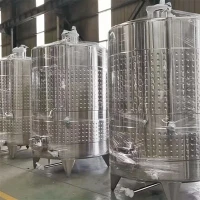
Core Identity: Transformation Workshop
Its most fundamental function is to provide a container where the pressed grape juice (or the grape mash with skins) and the yeast can mix together.
Here, the yeast acts as the "workers", converting the sugar in the grape juice into alcohol, carbon dioxide and various flavor substances, thus completing the qualitative transformation from juice to wine.
Key feature: Controllable environment
Modern wine fermentation tanks are far more than just a simple barrel. They integrate multiple control functions to enable winemakers to precisely shape the style of the wine:
Temperature control system: The tank usually has a jacket or coil that can be filled with cold or hot water, allowing for precise control of the fermentation temperature, similar to an air conditioner. This is crucial for preserving fruit aroma or extracting color and tannins.
Sealing and ventilation control: The tank can be sealed to isolate oxygen and maintain fresh fruit flavor; it can also be designed to allow a small amount of oxygen to enter to soften the tannins.
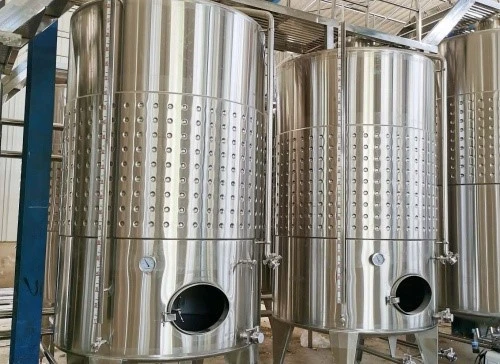
Easy management: The tank usually has valves, making it convenient for winemakers to take samples for monitoring; for red wine fermentation, the tank's design also facilitates operations such as "cap pressing" or "pump-juicing" to better extract color and flavor from the grape skins.
Application
Wine fermentation tanks are mainly installed in the following three types of places:
1. Commercial winery
This is the primary and most common application site for fermentation tanks.
Large breweries: Have a large group of fermentation tanks with capacities ranging from tens of thousands to hundreds of thousands of liters, achieving highly automated and large-scale production.
Premium/family wineries: Usually use a smaller number of tanks with moderate capacities, emphasizing more meticulous management. They may also have various types of tanks such as stainless steel tanks and oak barrels, to produce wines with complex styles.
Cooperative wineries: Owned by multiple grape growers, they centrally process and ferment the grapes submitted by the members. The scale and processing capacity of their fermentation tanks are usually also very large.
2. Laboratories and research institutions
Wine-making school and university: For teaching and research, to enable students to have an intuitive understanding of the fermentation process and control principles.
Research laboratory: For conducting cutting-edge scientific research such as yeast strain selection and fermentation process optimization. These fermentation tanks are usually small in size but have extremely high control accuracy.
3. Other alcohol beverage producers
Some manufacturers that produce other fruit wines or specific alcoholic beverages also use similar fermentation tanks.
Apple wine factory: For the fermentation of apple wine.
Other fruit wine factories: For the production of plum wine, cherry wine, etc.
Some craft breweries: Especially when brewing barrel-aged beers, they may
use wine oak barrels or large stainless steel tanks
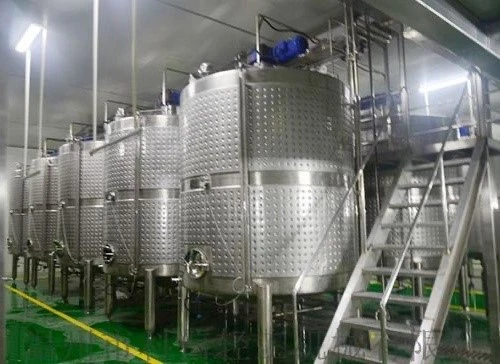
Parameter
| Category | Parameter | Description & Purpose | Common Examples / Range |
|---|---|---|---|
| Capacity & Dimensions | Total Volume | The maximum volume the tank can hold. | 1,000 L - 100,000 L (common for stainless steel) |
| Working Volume | The recommended volume for safe fermentation, accounting for foam and gas (typically 70-80% of total volume). | 700 L - 80,000 L (for a 1,000 L - 100,000 L tank) | |
| Height / Diameter Ratio | The ratio of the tank's height to its diameter. Affects extraction and hydrostatic pressure. | 1:1 (open for reds), 3:1 (tall for whites) | |
| Construction & Material | Material | The primary material the tank is made from, which impacts insulation, reactivity, and cost. | Stainless Steel (304 or 316L), Oak, Concrete, Fiberglass |
| Jacket Type | The external system for temperature control. | Full, Partial, Half-pipe Jacket | |
| Wall Thickness | The thickness of the tank wall, important for durability and pressure rating. | 1.5 mm - 3.0 mm (for stainless steel) | |
| Temperature Control | Cooling/Heating Surface | The area of the jacket in contact with the tank, determining heat exchange efficiency. | Calculated as m² per m³ of must |
| Temperature Range | The operational temperature range the tank can maintain. | 10°C - 35°C (50°F - 95°F) | |
| Cooling Method | The system used to circulate coolant through the jacket. | Glycol-Water Mixture, Chilled Water | |
| Monitoring & Accessories | Access Doors | Openings on the tank for inspection, cleaning, and grape entry/exit. | 500 mm diameter, various sizes |
| Pressure Rating | The maximum internal pressure the tank is designed to withstand. | Full Vacuum to 2.5 bar (for modern tanks) | |
| Sensors & Ports | Fittings for installing monitoring devices and sampling. | Thermowell, Sample Valve, CIP Ball |
Packing and Delivery
 Certificate

Customer Review

Hot Tags: wine fermentation tank manufacturer, China wine fermentation tank manufacturer manufacturers, suppliers, factory, Wine Fermentation Tank